Every year, right after Thanksgiving night,many families bring a Christmas tree into their home. It’s chosen carefully, welcomed with excitement, and placed in the very best spot—right where everyone can see it. The lights are tested, the ornaments unpacked, and the tree becomes the center of attention. Photos are taken. Memories are made. For weeks, it stands proudly, holding the joy of the season on its branches.
The tree serves its purpose beautifully. It gathers the family together. It creates warmth. It gives more than it takes.
Then December 25th passes…
Slowly, the lights come down. The ornaments are wrapped away. The tree that once held such value is now quietly carried out, no longer needed in the same way. Its role is finished.
Life can feel like this sometimes.
There will be moments when people treat you like a Christmas tree. They welcome you, place you in an important spot, and rely on you for comfort, support, love, or strength. And then—when the season changes—they move on. It can sting if you’re not prepared. But it doesn’t mean your worth disappeared. It means your purpose was fulfilled.
Don’t be surprised. Don’t feel remorse. Be grateful that you were able to be what someone needed, exactly when they needed it. Some connections are meant to be permanent; others are meant to be meaningful for a moment. Like the Christmas tree, your value was real—even if it wasn’t forever.
“There is a quiet fulfillment in knowing you showed up fully for someone, even if your presence was only meant to last for a season.”
Gratitude isn’t just a polite “thank you.” It’s a powerful attitude that can transform how we feel — and how we live. When we take time to reflect on the good in our lives, we give our minds a break from negativity and start training ourselves to notice what truly matters. Research across psychology and physical health shows that regularly practicing gratitude can reduce stress, lower the risk of depression, and improve overall mood and well-being. It can also help us sleep better, take better care of our bodies, and even support cardiovascular health.
On a deeper level, gratitude strengthens our relationships. By acknowledging the kindness of others — or appreciating what we have — we nurture empathy and connection. Gratitude reminds us we are part of something bigger than ourselves. Most importantly, gratitude is a habit — one we can cultivate. Whether through journaling, a nightly reflection, or simply pausing to appreciate a small blessing, daily gratitude quietly rewires our mind toward positivity, resilience, and meaningful living.
Why not try it today? Take a minute now to reflect on something you’re grateful for — it could change your whole day.
Growing up, Mia always felt a quiet emptiness that she couldn’t quite name. Her childhood, although surrounded by the familiarity of home, was often marked by an absence of warmth that she couldn’t ignore. While other children seemed to have an easy, instinctive bond with their parents, Mia struggled. The love she sought from her mother never seemed to materialize in the way she needed. Her mother’s love was distant, inconsistent, and, at times, almost detached. Mia’s needs were often overshadowed by her mother’s own emotional distance and struggles, leaving Mia to fend for herself emotionally, trying, and failing, to feel a deep connection with the one person who should have been her closest confidante.
From an early age, Mia observed the lack of nurturing in her relationship with her mother. There was no warm embrace after a long day, no encouraging words when she was faced with challenges, and no validation of her feelings. Her mother seemed preoccupied, focused more on her own world than on Mia’s needs. As Mia grew older, the void only deepened. In school, while her peers ran to their mothers for comfort, Mia learned to retreat into herself, holding her emotions close. She carried a quiet ache, never feeling the unconditional love that she saw in others. When her friends spoke about their mothers with warmth and fondness, Mia would smile politely, but inside, the longing was unbearable.
This absence of love from her biological parents—especially from her mother—cast a long shadow on Mia’s adult relationships. She sought validation in every romantic partner, searching desperately for the affection and approval she never received as a child. Each relationship began with hope, but soon, her unmet needs would surface. She would feel disconnected or misunderstood, unable to truly trust the love she was being given. She constantly questioned whether she was worthy of love, a habit she’d unconsciously learned growing up. This insecurity would often lead to tension, arguments, and eventually, heartbreak. She couldn’t help but wonder, “Why can’t I feel loved the way others do?”
As Mia navigated her relationships, the pattern was always the same. She would pour herself into her partners, hoping they would fill the void left by her mother, only to feel unsatisfied, lost, and uncertain. The cycle of trying to heal wounds with external validation never worked. Mia’s struggle wasn’t about finding the right person; it was about finding a way to love herself when the love she craved from her parents was never forthcoming.
Mia’s story isn’t uncommon. Many people, especially those who didn’t receive the love and support they needed from their biological parents, struggle with deep feelings of inadequacy and seek to fill that void with external sources of love. However, Mia needs to realize that her healing doesn’t depend on changing her parents, but on changing her relationship with herself. Her mother may never be the nurturing, warm figure she dreams of. And the truth is, Mia can’t force her mother to love her in the way she needs or deserves.
The most crucial step Mia must take is to accept that her parents—especially her mother—may never be able to offer the love she wants. It’s a painful realization, but it’s essential for her emotional freedom. Mia must let go of the hope that they will suddenly become the loving, attentive parents she longs for. Instead, she needs to learn to love herself fully and to heal the wounds of her past. Self-love isn’t easy, but it’s the only love that will truly fill the emptiness. She must surround herself with people who uplift and support her, not to replace her parents, but to build a chosen family of love and care.
By letting go of the unrealistic expectation that her parents will change, Mia can finally free herself from the cycle of seeking validation from others. Only then can she move forward into healthier, more fulfilling relationships. True love—starting with self-love—will help Mia heal and embrace the life she deserves.
Do you know a Mia? Are you a Mia? Do you have an advice for Mia?
If you know me, or read my first post, you know how my family’s dynamic is one of my biggest trigger however, over this weekend I realized as much that I miss being raise by my parents, and as much as I miss knowing there is someone who loves me unconditionally. Family is not my trigger at all…
Trigger, to me, is that thing that reminds me of my demons. It’s that thing that my demons use to bully me.
My family is not my trigger. My indiscipline, my lack of responsibility, my lack of self-control, my lack of routine are my triggers/demons.
I have blamed “not knowing the love of my mom or dad” as the cause of all my issues. It took me one zoom meeting and good energy to realize that MY BEHAVIOR IS MY TRIGGER/DEMON. Many clinical Psychologists will disagree with me because similar to FREUD “they believe that events in our childhood can have a significant impact on our behavior as adults.”
Nevertheless, I think – As an adult, what do we do when we realized that we are on the wrong path? How do we proceed to get our life on the track that we want?- I am sure that the moment we can ask ourselves those two questions, we can start the healing process.
I don’t know what you think your trigger is but, I advise you to look deep into what prompt your emotions out of control; since, it is the first step into getting better.
Glad that I am on my healing journey. It will take me some times, but I believe I will get there. “Wish me luck 🤗
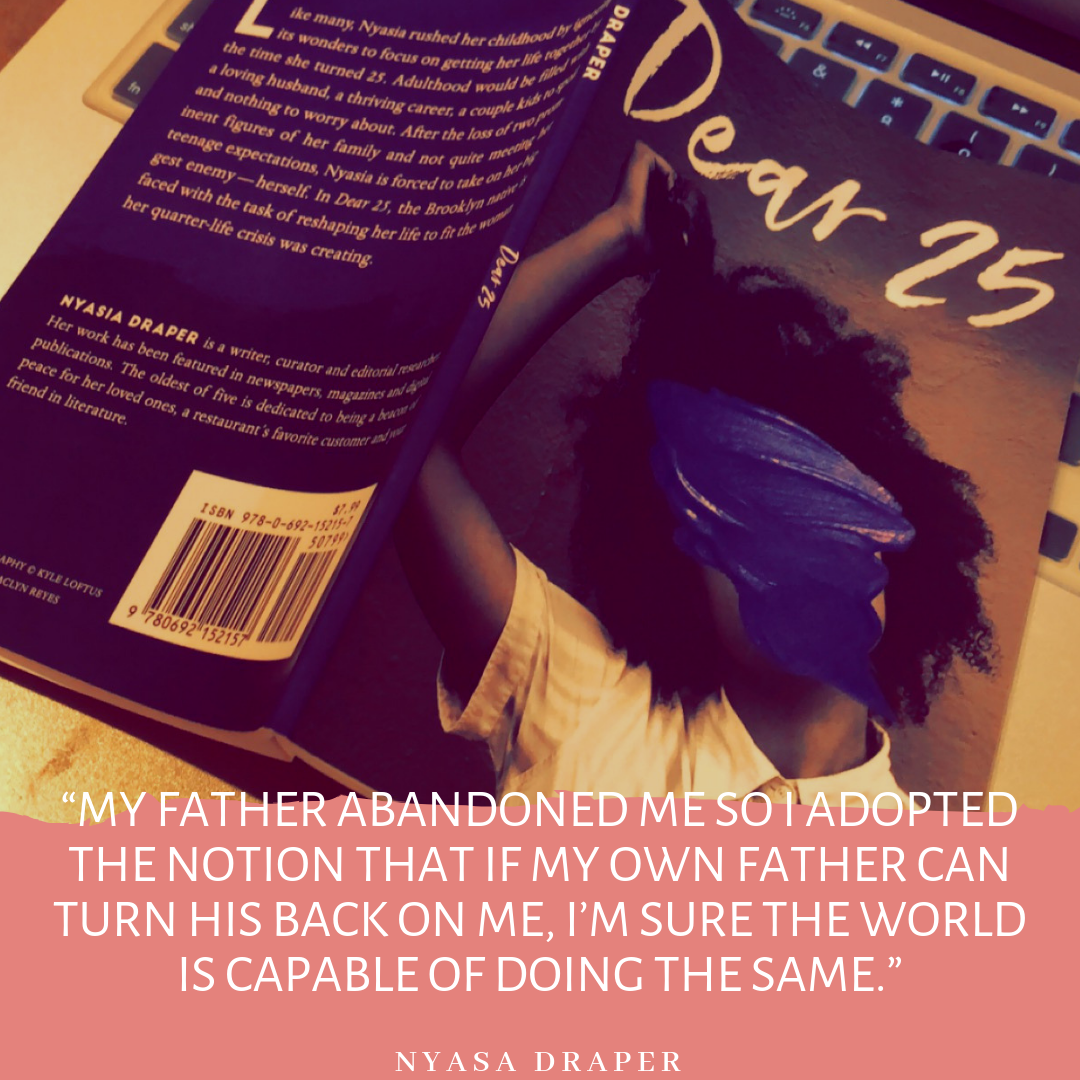
Nyasia Draper used her struggle to inspire others. I can relate to her story so much that at one point I felt that I was reading my own story. When you’re reading the book it feels like she was having a conversation with you. It is wonderful to read about a young woman that is on her journey to success. Usually people wait until they reach their goals before talking about their lives.
I am thankful that Nyasia didn’t wait to write Dear 25 because this book is a “marche a suivre” for anyone who feels their life is not where they plan it to be.
Dear Nyasia you did great by not going to therapy because I would not have the opportunity to learn from your story if you did, so thank you! Fantastic read! I encourage everyone to read this book! I can’t wait to read the next one.
We usually give credit to people who are successful, but ignore those that are on their own road to success forgetting that those successful people were once beginners as well.
Maybe this is what is stopping you from starting your journey to the “great life” health, wealth, and happiness. If you do not take time to know someone else’s path you will think it just happened that they are where they are. For example, if you want to be the next LeBron James, one of the best basketball players who many refer as The King, and you do not know his story, do not even know how many hours he puts every day into practice, you will never be able to follow his footsteps.
We put successful people on a pedestal and that, my friend, is what is stopping you from starting your journey to success. We have a tendency to think successful people are geniuses. Do not get me wrong, most of them are, but I also believe we are all a genius. Oprah Winfrey is a genius but so is J.K. Rowling, Arnold Schwarzenegger, Grant Cardone, and Jeff Bezos. They are all geniuses in their own way.
We need to know their path and their routine, if you ever read a biography you’ll realize most almost every successful person has a routine, things that they do in a regular basis that lead them to their success. One thing that they all have in common is improving themselves every day in the field they are in. My advice to you if you are really serious about your success you must work every day to become the best at what you do.
You will never change your life until you change something you do daily. The secret of your success is found in your daily routine.John C. Maxwell






 Itsup2you