The most difficult thing is the decision to act, the rest is merely tenacity. The fears are paper tigers. You can do anything you decide to do. You can act to change and control your life; and the procedure, the process is its own reward. Amelia Earhart
Every year, right after Thanksgiving night,many families bring a Christmas tree into their home. It’s chosen carefully, welcomed with excitement, and placed in the very best spot—right where everyone can see it. The lights are tested, the ornaments unpacked, and the tree becomes the center of attention. Photos are taken. Memories are made. For weeks, it stands proudly, holding the joy of the season on its branches.
The tree serves its purpose beautifully. It gathers the family together. It creates warmth. It gives more than it takes.
Then December 25th passes…
Slowly, the lights come down. The ornaments are wrapped away. The tree that once held such value is now quietly carried out, no longer needed in the same way. Its role is finished.
Life can feel like this sometimes.
There will be moments when people treat you like a Christmas tree. They welcome you, place you in an important spot, and rely on you for comfort, support, love, or strength. And then—when the season changes—they move on. It can sting if you’re not prepared. But it doesn’t mean your worth disappeared. It means your purpose was fulfilled.
Don’t be surprised. Don’t feel remorse. Be grateful that you were able to be what someone needed, exactly when they needed it. Some connections are meant to be permanent; others are meant to be meaningful for a moment. Like the Christmas tree, your value was real—even if it wasn’t forever.
“There is a quiet fulfillment in knowing you showed up fully for someone, even if your presence was only meant to last for a season.”
“Let go of who you think you’re supposed to be; embrace who you are.” — Brené Brown
This quote speaks to one of the deepest struggles we face as human beings: the tension between external expectations and our authentic selves. From childhood, we are shaped by family beliefs, cultural norms, and social pressures that tell us who we should be—how we should act, speak, succeed, and even feel. Over time, these expectations can become a heavy mask, disconnecting us from our true identity and creating a life that pleases others but fails to nourish our own spirit.
Letting go of who we think we’re “supposed” to be is not an act of rebellion; it is an act of liberation. It requires courage to question the roles we’ve adopted and to acknowledge the parts of ourselves we have silenced for acceptance. Embracing who we truly are means choosing honesty over perfection, presence over performance, and self-compassion over self-judgment. It invites us to recognize our strengths, vulnerabilities, and unique gifts without apology.
When we align with our authentic selves, we step into a life that feels lighter, more meaningful, and more grounded. We begin to create relationships built on truth rather than image, make decisions that reflect our values, and develop confidence from within rather than from the approval of others. Ultimately, Brown’s message reminds us that authenticity is not a destination—it is a daily practice of returning to ourselves with patience, love, and the belief that we are enough just as we are.
Gratitude isn’t just a polite “thank you.” It’s a powerful attitude that can transform how we feel — and how we live. When we take time to reflect on the good in our lives, we give our minds a break from negativity and start training ourselves to notice what truly matters. Research across psychology and physical health shows that regularly practicing gratitude can reduce stress, lower the risk of depression, and improve overall mood and well-being. It can also help us sleep better, take better care of our bodies, and even support cardiovascular health.
On a deeper level, gratitude strengthens our relationships. By acknowledging the kindness of others — or appreciating what we have — we nurture empathy and connection. Gratitude reminds us we are part of something bigger than ourselves. Most importantly, gratitude is a habit — one we can cultivate. Whether through journaling, a nightly reflection, or simply pausing to appreciate a small blessing, daily gratitude quietly rewires our mind toward positivity, resilience, and meaningful living.
Why not try it today? Take a minute now to reflect on something you’re grateful for — it could change your whole day.
Growing up, Mia always felt a quiet emptiness that she couldn’t quite name. Her childhood, although surrounded by the familiarity of home, was often marked by an absence of warmth that she couldn’t ignore. While other children seemed to have an easy, instinctive bond with their parents, Mia struggled. The love she sought from her mother never seemed to materialize in the way she needed. Her mother’s love was distant, inconsistent, and, at times, almost detached. Mia’s needs were often overshadowed by her mother’s own emotional distance and struggles, leaving Mia to fend for herself emotionally, trying, and failing, to feel a deep connection with the one person who should have been her closest confidante.
From an early age, Mia observed the lack of nurturing in her relationship with her mother. There was no warm embrace after a long day, no encouraging words when she was faced with challenges, and no validation of her feelings. Her mother seemed preoccupied, focused more on her own world than on Mia’s needs. As Mia grew older, the void only deepened. In school, while her peers ran to their mothers for comfort, Mia learned to retreat into herself, holding her emotions close. She carried a quiet ache, never feeling the unconditional love that she saw in others. When her friends spoke about their mothers with warmth and fondness, Mia would smile politely, but inside, the longing was unbearable.
This absence of love from her biological parents—especially from her mother—cast a long shadow on Mia’s adult relationships. She sought validation in every romantic partner, searching desperately for the affection and approval she never received as a child. Each relationship began with hope, but soon, her unmet needs would surface. She would feel disconnected or misunderstood, unable to truly trust the love she was being given. She constantly questioned whether she was worthy of love, a habit she’d unconsciously learned growing up. This insecurity would often lead to tension, arguments, and eventually, heartbreak. She couldn’t help but wonder, “Why can’t I feel loved the way others do?”
As Mia navigated her relationships, the pattern was always the same. She would pour herself into her partners, hoping they would fill the void left by her mother, only to feel unsatisfied, lost, and uncertain. The cycle of trying to heal wounds with external validation never worked. Mia’s struggle wasn’t about finding the right person; it was about finding a way to love herself when the love she craved from her parents was never forthcoming.
Mia’s story isn’t uncommon. Many people, especially those who didn’t receive the love and support they needed from their biological parents, struggle with deep feelings of inadequacy and seek to fill that void with external sources of love. However, Mia needs to realize that her healing doesn’t depend on changing her parents, but on changing her relationship with herself. Her mother may never be the nurturing, warm figure she dreams of. And the truth is, Mia can’t force her mother to love her in the way she needs or deserves.
The most crucial step Mia must take is to accept that her parents—especially her mother—may never be able to offer the love she wants. It’s a painful realization, but it’s essential for her emotional freedom. Mia must let go of the hope that they will suddenly become the loving, attentive parents she longs for. Instead, she needs to learn to love herself fully and to heal the wounds of her past. Self-love isn’t easy, but it’s the only love that will truly fill the emptiness. She must surround herself with people who uplift and support her, not to replace her parents, but to build a chosen family of love and care.
By letting go of the unrealistic expectation that her parents will change, Mia can finally free herself from the cycle of seeking validation from others. Only then can she move forward into healthier, more fulfilling relationships. True love—starting with self-love—will help Mia heal and embrace the life she deserves.
Do you know a Mia? Are you a Mia? Do you have an advice for Mia?
One day, I asked a friend why we cannot discuss our mental health as we talk about diabetes, blood pressure, asthma… he said: “because none of those can cause you to hurt yourself or others.” That made me think oppositely. So we must talk about our mental health more than anything 🤷🏾♀️ because it affects the “sick person” and the whole family, community, state, country…
Hi, I am a Nephtalie. I have demons who come to visit once a while. But the universe gave me tools, friends, authors, strangers to help me fight them all. And today, I can proudly say suicide will never be an option!
Please, for your welfare and your loved one sake, talk to your friends. Seek professional help. As they can manage their asthma, we can control our mental health with the right guidance. Reach out to your friends. You never know the “strong ones” might be concealing their weakness.
“Anything that’s human is mentionable, and anything that is mentionable can be more manageable. When we can talk about our feelings, they become less overwhelming, less upsetting, and less scary.” – Fred Rogers
Would you believe me if I tell you everything will be okay? Would you stop crying if I tell you the situation that makes you think life is worthless will make perfect sense in the future, and you will be grateful for it? Please, I am the living proof!
I was rejected by almost every family member when I was 17. You’re probably asking why? What did you do?
I stood up against my predator.
And would have done the same thing again today regardless of all the awful things that happened in my life because I didn’t let him take a piece of me.
Today I am grateful for my story because it makes me ME. My friends think that I am strong because I didn’t/ don’t let go. But, I believe that I am just a strong woman who knows her weakness. I took some selfish decisions because I wasn’t strong enough for the reality.
Here I am today, right where I belong with my lovely tow kids who are giving me every reason to continue this journey!
Please remember you are going through this because you have what it takes to turn it into the best chapter of your story.
If you know me, or read my first post, you know how my family’s dynamic is one of my biggest trigger however, over this weekend I realized as much that I miss being raise by my parents, and as much as I miss knowing there is someone who loves me unconditionally. Family is not my trigger at all…
Trigger, to me, is that thing that reminds me of my demons. It’s that thing that my demons use to bully me.
My family is not my trigger. My indiscipline, my lack of responsibility, my lack of self-control, my lack of routine are my triggers/demons.
I have blamed “not knowing the love of my mom or dad” as the cause of all my issues. It took me one zoom meeting and good energy to realize that MY BEHAVIOR IS MY TRIGGER/DEMON. Many clinical Psychologists will disagree with me because similar to FREUD “they believe that events in our childhood can have a significant impact on our behavior as adults.”
Nevertheless, I think – As an adult, what do we do when we realized that we are on the wrong path? How do we proceed to get our life on the track that we want?- I am sure that the moment we can ask ourselves those two questions, we can start the healing process.
I don’t know what you think your trigger is but, I advise you to look deep into what prompt your emotions out of control; since, it is the first step into getting better.
Glad that I am on my healing journey. It will take me some times, but I believe I will get there. “Wish me luck 🤗
It is always in my heart to thank publicly the people who played an essential role in helping me become the best version of myself. Side joke, I was waiting for my victory speech to do so, then I realized every day deserve a victory speech; because today means that we won the battles of yesterday. In the center of the tornado of my life, at 17, many people came to my rescue, however, there were four rescuers who stood out, and today I want to let them know the role they play in my life.
Leo Devastey,he gave me another chance to experience life. He literally saved my life by giving me my first paying job. When you’re 17 without a mother, father, nor a godmother in a country like Haiti, being able to have a job is a privilege. My experience as a radio DJ and news anchor was the genesis of becoming Nephtalie. The time that I spent at Radio Phare helped me become a bright young woman. I was able to carry a conversation with some well-educated people who believed that I was one of them while I was still in high school. I thank you Leo, and I will be forever grateful! You are the first person that shows me that there can be light in the darkness.
Gesner Mervilus, I call him dad because he helped me like a father could have helped his daughter. My meeting with Gesner was pure coincidence or faith, thus, he made an essential impact in my life. Thank you, Gesner, for all the effort you put into getting me the job, even it did not work out, but I know that you’ve tried with all your heart. You’re the second light in my darkness.
Alain Julsaint,I am literally in tears right now because he is not around anymore, and I am not sure that he knew how his life make mine better. Alain Julsaint was the person who shaped my confidence, he made me believed that I had what it takes. With a smile, he said to me once “you can do this” when I was having second thought about my ability to finish high school while I was working full time. His concept of the education system in Haiti allows me to finish high school, and eventually to be the person I am today. I thank you Alain, and I will be forever grateful. You’re the third light in my darkness. “Un petit bey bey the loin Mrs. Julsaint.”
Jean Diderot Abellard, I still get emotional every time I think about what he did for me. He saw something in me that I did not even see myself. In June 2005, he made the decision to help me like I was his little sister. Still, wonder why did he help me? Because the people who were supposed to be there for me were playing “No Show.” I will be forever grateful for your gesture. You’re the fourth light in my darkness.
Thank you, Leo, Gesner, Alain, and Diderot I am still working on making you proud.
A bold and golden thank you to every single people who had the opportunity to help me but, did not. Thank you, to all of you who were cheering at my failure. Thank you, because your attitude and rejection gave me the strength to fight in the darkest, and weakest moments of my life. When things seem impossible, I do not bend down nor declare forfeit because of you.
Knowing that you were waiting for me to fail gave me more determination to keep fighting.
So as much as I thank and love the people that: embraced me, listened to me, guided me, supported me, encouraged me, reminded me of my goals when I was down, reminded me that I can succeed; Is as much that I thank and love the one who rejected me and still hate me. Because, maybe, just maybe without their resentment I would not have fought as hard that I did to get in the road that will make me the Nephtalie I want to be.
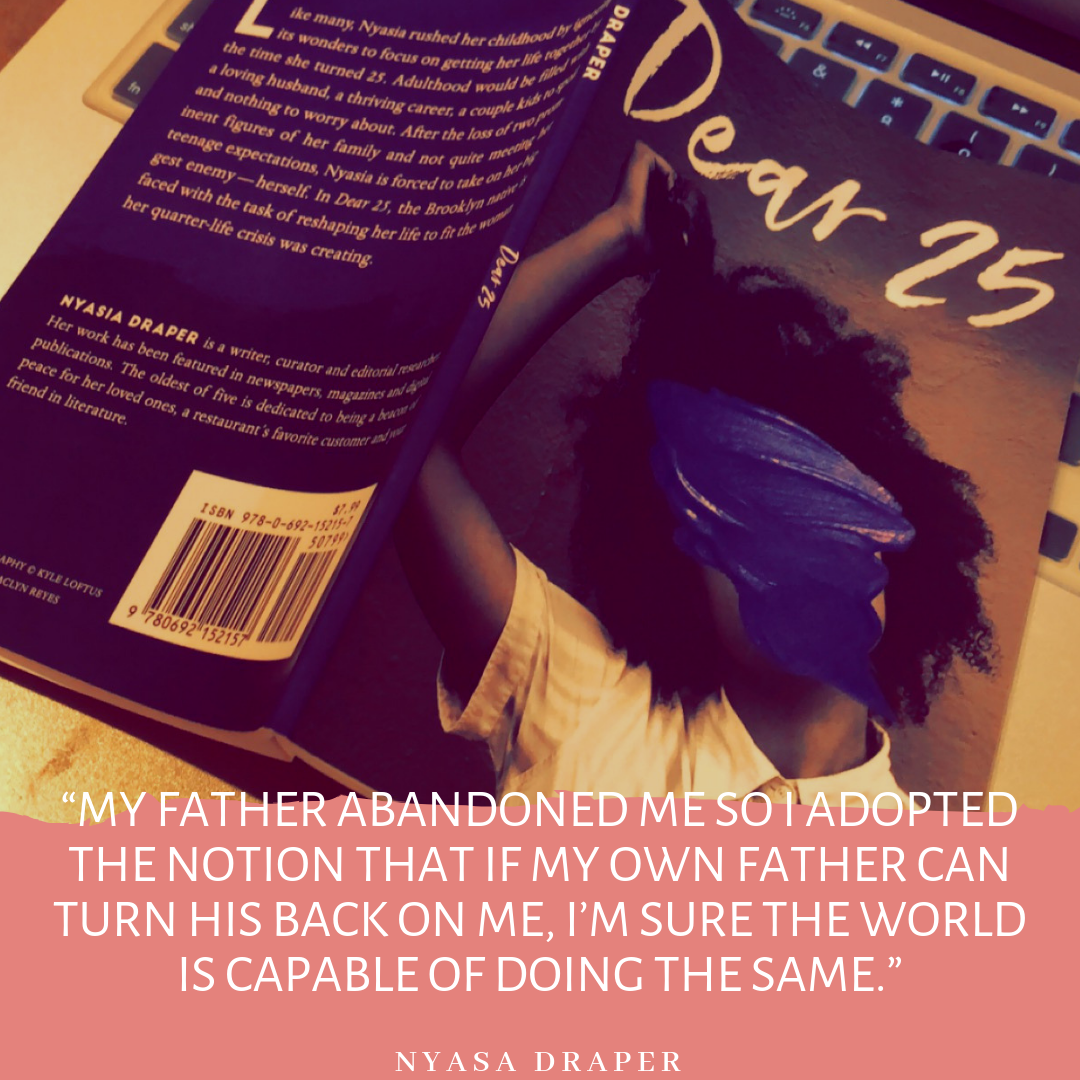
Nyasia Draper used her struggle to inspire others. I can relate to her story so much that at one point I felt that I was reading my own story. When you’re reading the book it feels like she was having a conversation with you. It is wonderful to read about a young woman that is on her journey to success. Usually people wait until they reach their goals before talking about their lives.
I am thankful that Nyasia didn’t wait to write Dear 25 because this book is a “marche a suivre” for anyone who feels their life is not where they plan it to be.
Dear Nyasia you did great by not going to therapy because I would not have the opportunity to learn from your story if you did, so thank you! Fantastic read! I encourage everyone to read this book! I can’t wait to read the next one.

 Itsup2you